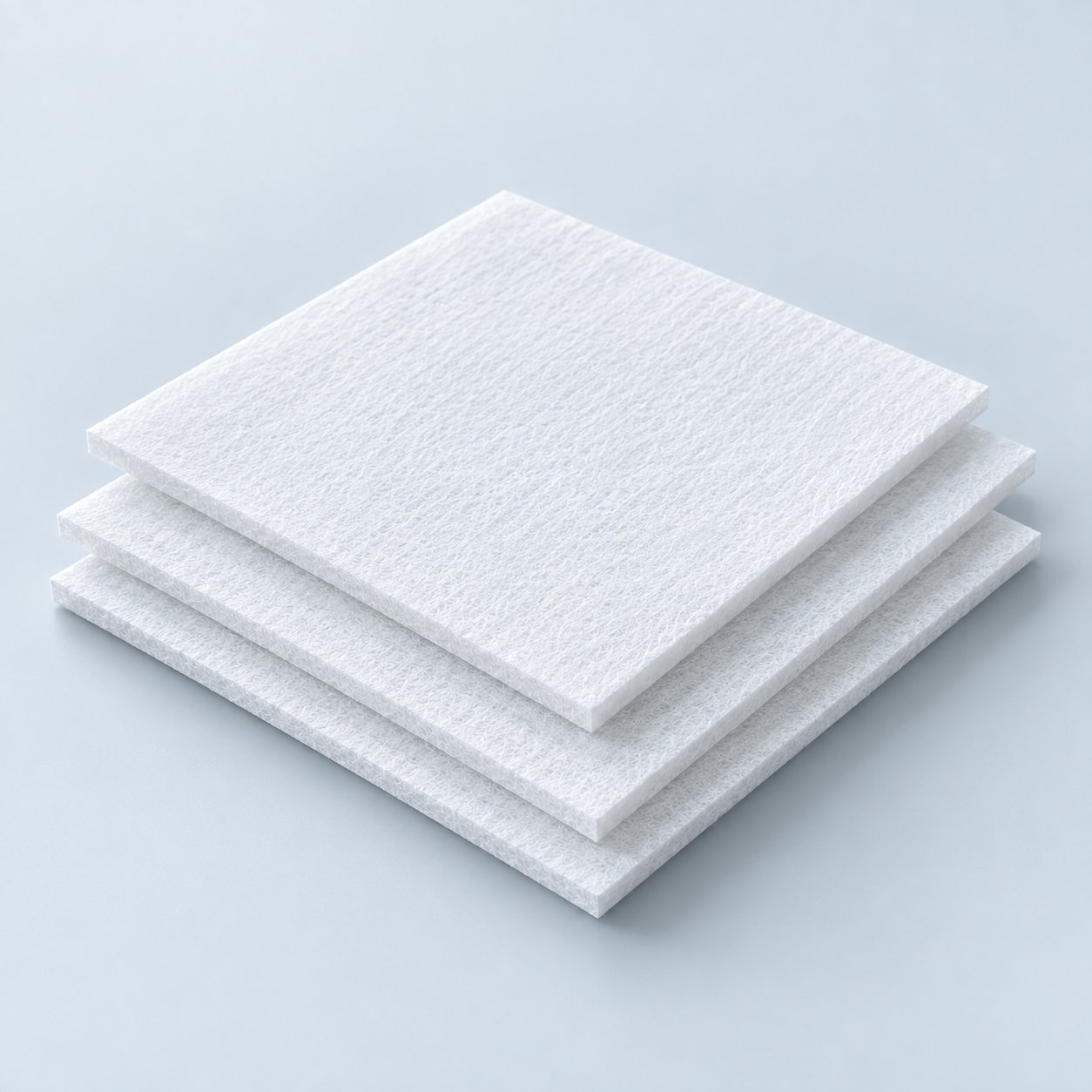
Cleaning can move the load somewhere else
A mop or wipe picks up soil, particles or microbial load from a surface. But when the same product moves on to the next surface, it can leave part of that load behind. In a controlled area the main risk is often not the first surface wiped but the clean surface the product touches next. We call this secondary transfer cross-contamination; OWMO's test matrix addresses it as the "double contamination" test.
Cleaning efficiency and transfer risk are not the same thing. A product can reduce the load on a surface well and still release what it carries onto the next one. The two measurements are therefore reported separately.
This article summarises, especially for QA, microbiology and infection control teams, how a two-stage test is set up, how its result is read and what it does not prove.
The logic of the two-stage protocol
The definition OWMO proposes has two steps:
The product is used with a standard movement on a surface carrying a defined soil, particle or microbial load.
The same product is then moved onto a new, clean surface, and the load transferred to this second surface is measured.
The result is reported as the load carried to the second surface, usually as a transfer percentage; the report should define what the percentage is calculated against. The figure describes not only how much the product picks up, but how well it holds on to what it has picked up.
What the protocol must fix
Transfer results cannot be compared unless the conditions are defined. A protocol should state at least:
Load type: soil, particles or microbial load; its kind and the amount applied.
Surfaces: the material of the first and second surface (for example stainless steel, glass or floor covering) and their area.
Movement: pressure, direction, speed and number of passes; identical for every sample.
Wetting: dry use, or the type, concentration and impregnation volume of the liquid or chemical.
Product configuration: layer count, grammage, size, material and edge/attachment construction.
Measurement: how the load on the second surface is recovered and counted, the result unit and the number of replicates.
Control: a baseline measurement showing that the second surface was actually clean before the test.
For OWMO, the laboratory test name, method and report number are added by the quality team for each configuration. A percentage without method information should not be used for comparison.
How to read the result
Transfer results vary with layer count, grammage and size. Each configuration is therefore reported separately; the result for a 3-layer mop does not carry over to a 4-layer construction in the same family. When reading a result, check:
Is the sample in the report the same configuration as the SKU you are evaluating?
Do the load type and surface match the risk in your area?
Does the wetting condition match the chemical and volume you use?
Is a cleaning efficiency result given separately?
What the test means in the field
A laboratory result gains meaning together with the working method on site. OWMO's surface-based working method proposes these principles to reduce transfer risk:
On equipment, a wipe suited to the surface and a fresh fold for each new face.
On floors, a defined one-direction or S pattern from clean to dirty, with a set change frequency.
In transfer areas, separate products, colours or lots between zones.
For spills, containment from the edge towards the centre, followed by absorption.
These principles are adapted to the facility's own SOP and risk analysis; the final rule is the facility's approved procedure.
A laboratory protocol and a field protocol are not the same thing either. In OWMO's technical sales flow, two separate steps follow the lot-numbered sample: a field protocol defining use volume, movement, change and waste, and a validation reviewing particle, transfer, cleaning and cycle acceptance. The laboratory result feeds these steps; it does not replace them.
What the test does not prove
A transfer test does not show that contamination is fully prevented. The outcome depends on the facility, personnel, chemistry and SOP; the accurate statement is the transfer or cleaning efficiency measured under a defined condition.
It does not show that a product is sterile or that it maintains a room's ISO class. Environment class, sterile status and product suitability are handled with separate evidence.
In hospital areas the infection control plan and local protocol are decisive; a protocol set up for a pharmaceutical or electronics cleanroom does not transfer directly to a hospital.
Next step
If you share your area, surface types, main load type and the chemical you use, the configurations to be evaluated and their transfer results are confirmed per product at the sample and quotation stage. Use the technical consultation page to get started.
All posts